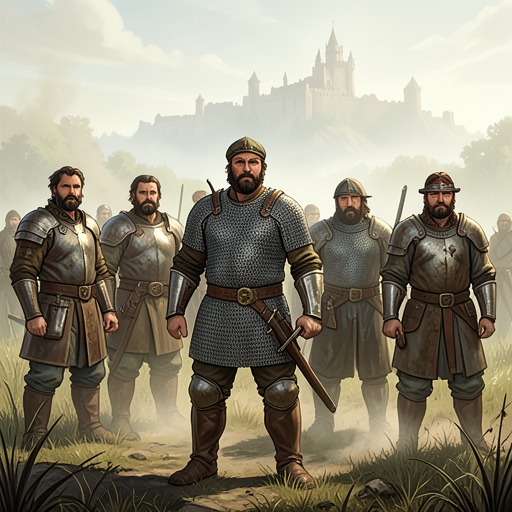
Robert d'Artois
Foucault's PendulumRobert d'Artois is the ambitious younger brother of Louis IX whose hunger for glory helps turn the Seventh Crusade’s promising advance into a disastrous assault on Mansura. By urging the king toward Cairo and then challenging the Templars’ honor, he draws the army into a pursuit that ends with his death and heavy losses among the knights.
Role in the Egyptian Campaign
After Louis IX’s forces landed successfully at Damietta and found the city abandoned, the king had to choose whether to advance toward Alexandria or Cairo. Alexandria offered the wiser strategic objective, but Robert, described as a megalomaniac hungry for glory, urged Louis to strike at Cairo, the heart of Egypt. The Templars, initially cautious, became eager for battle as the campaign advanced.
At a ford near Mansura, the main Christian force crossed the river with the Templars in the vanguard. When the opposing horsemen fled, Robert and his men broke away in pursuit instead of waiting for the rest of the army. His decision converted an initial success into a dangerous, unsupported advance.
Conflict with the Templars
The Templars joined the assault to avoid dishonor and caught up with Robert after he had entered the enemy camp and begun a massacre. When the opposing forces withdrew toward Mansura, Robert pursued them again. The Temple’s commander, Brother Gilles, tried to restrain him by praising his achievement, but Robert answered with an accusation: he claimed the Templars and Hospitallers could have conquered the territory long before if they had truly wanted to, and that he had shown what a man with blood in his veins could accomplish.
The accusation made the Templars’ standing as warriors the immediate issue. Rather than allow Robert’s taunt to define them as inferior, they charged into the city and pursued the enemy to its far wall. Robert’s pursuit and the Templars’ response thus became entangled: his desire for distinction prompted the very demonstration of martial honor that exposed them to disaster.
Death and Consequences
The Christians had repeated the strategic mistake associated with Ascalon. While they were occupied in the sultan’s palace, their opponents regrouped and attacked the disorganized force. Brother Gilles is said to have warned Robert, before following him into the city, that the knights were not afraid but doubted any of them would return. Robert was killed, as were many other knights, including 280 Templars.
The narrative presents his death not simply as a battlefield loss but as the consequence of a chain of choices: the advance toward Cairo, the breakaway pursuit after the river crossing, and the renewed chase toward Mansura. The episode is described as a disgrace as well as a defeat, though Joinville did not record it in those terms. The account’s contrast between the pursuit of glory and the resulting losses makes Robert a pivotal figure in the campaign’s reversal.